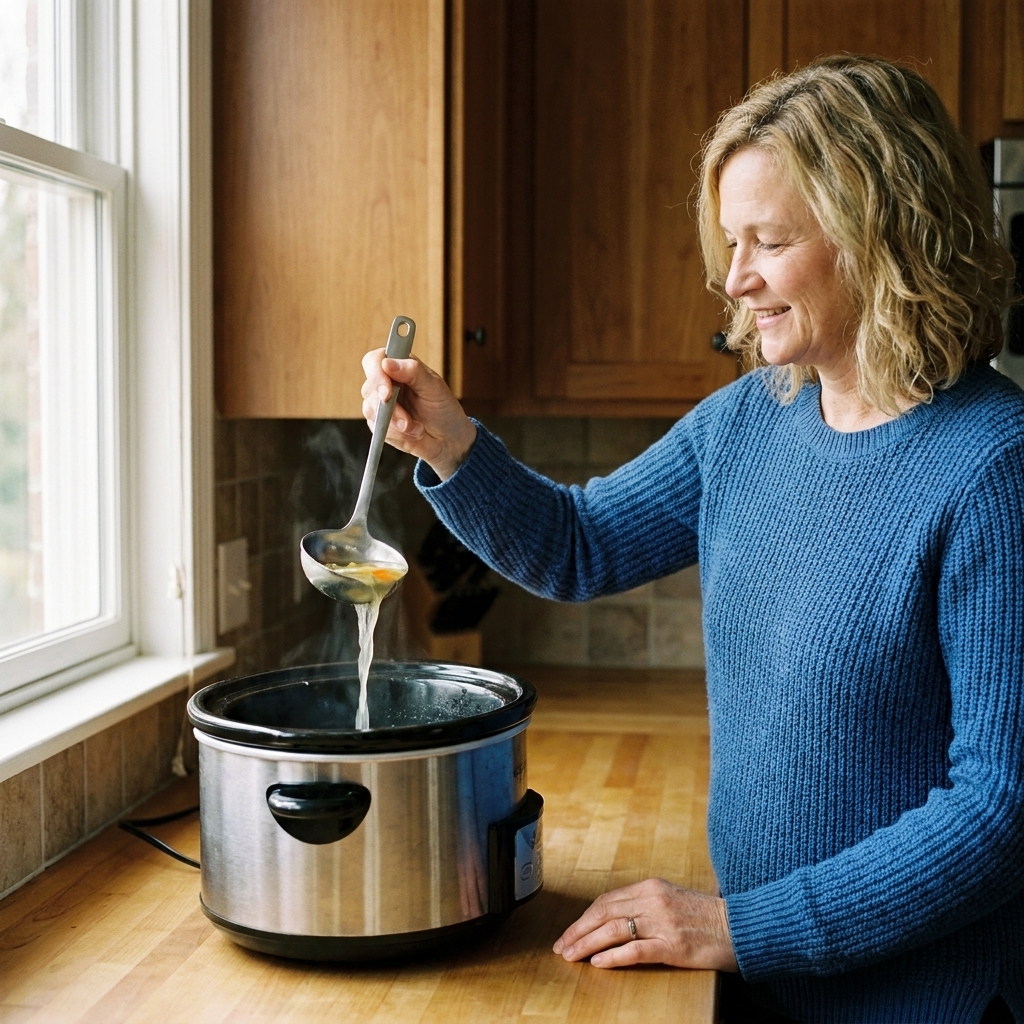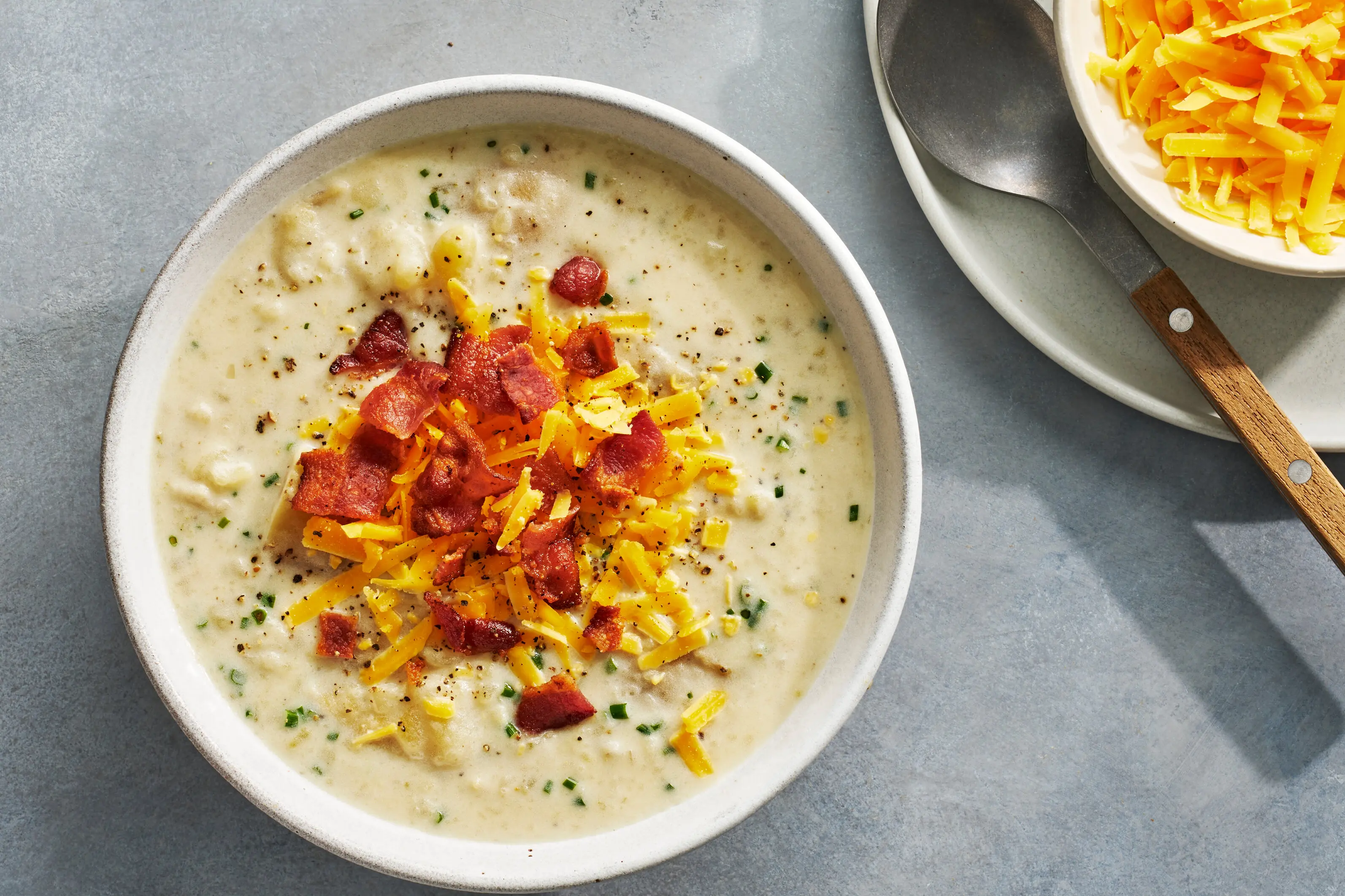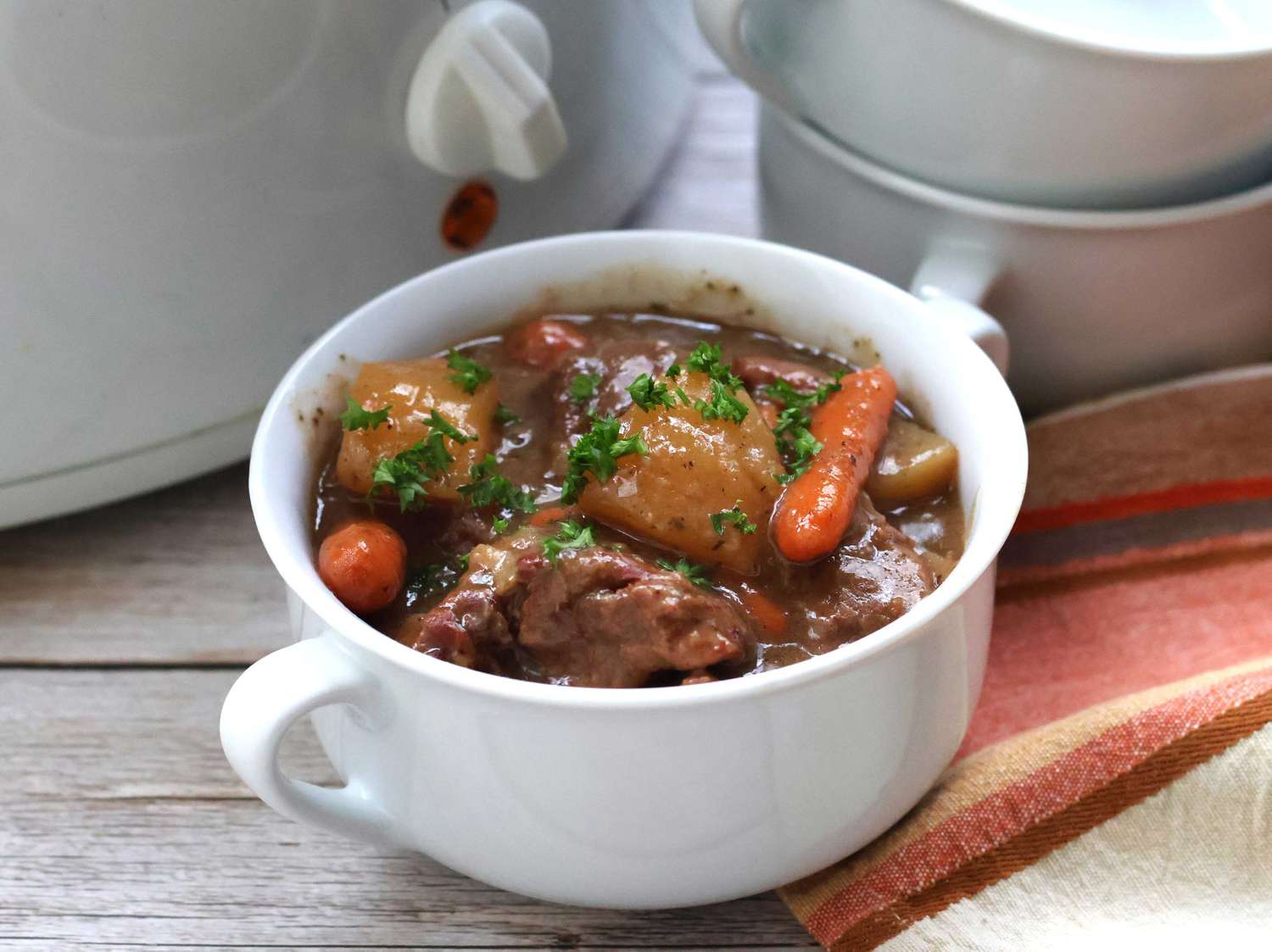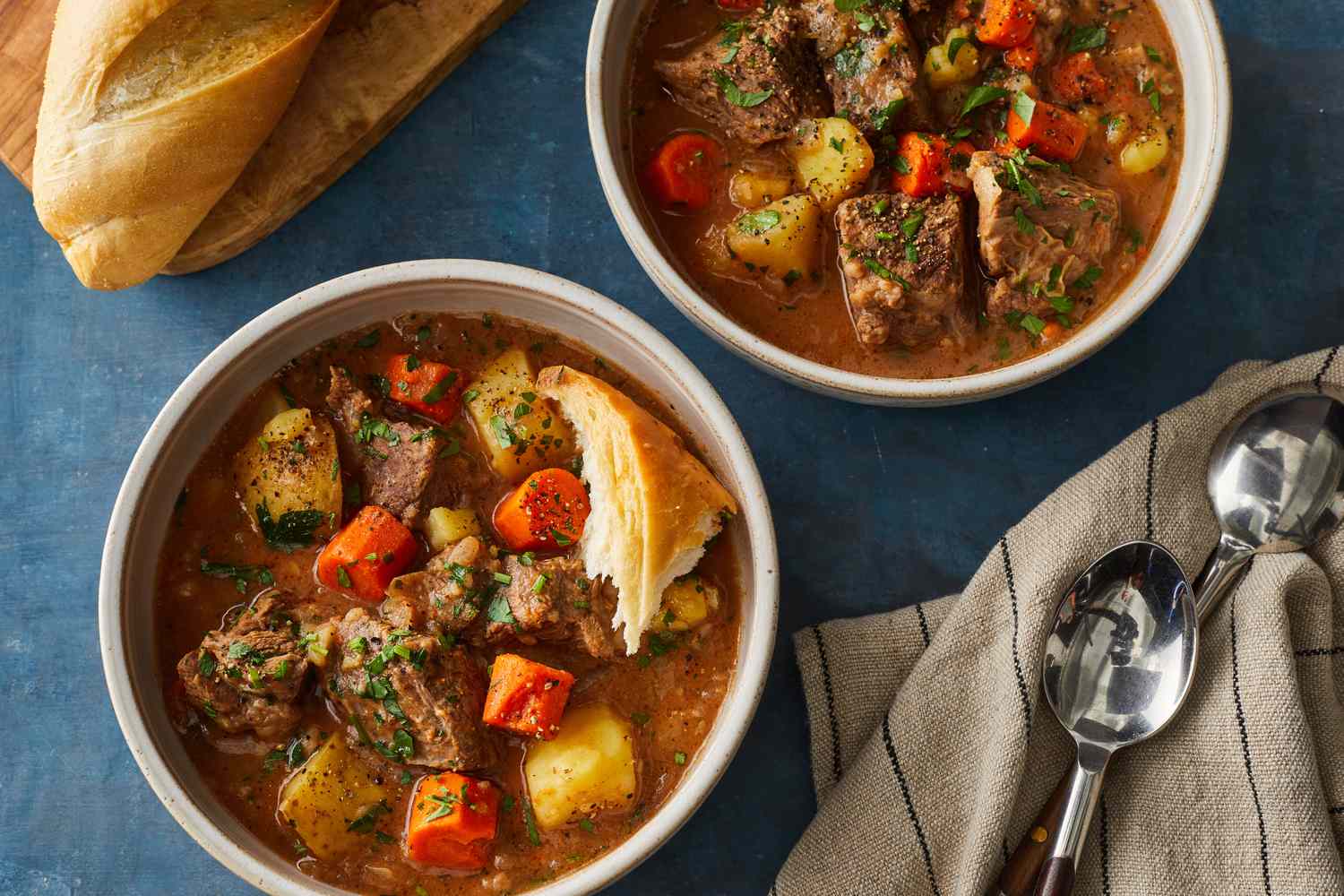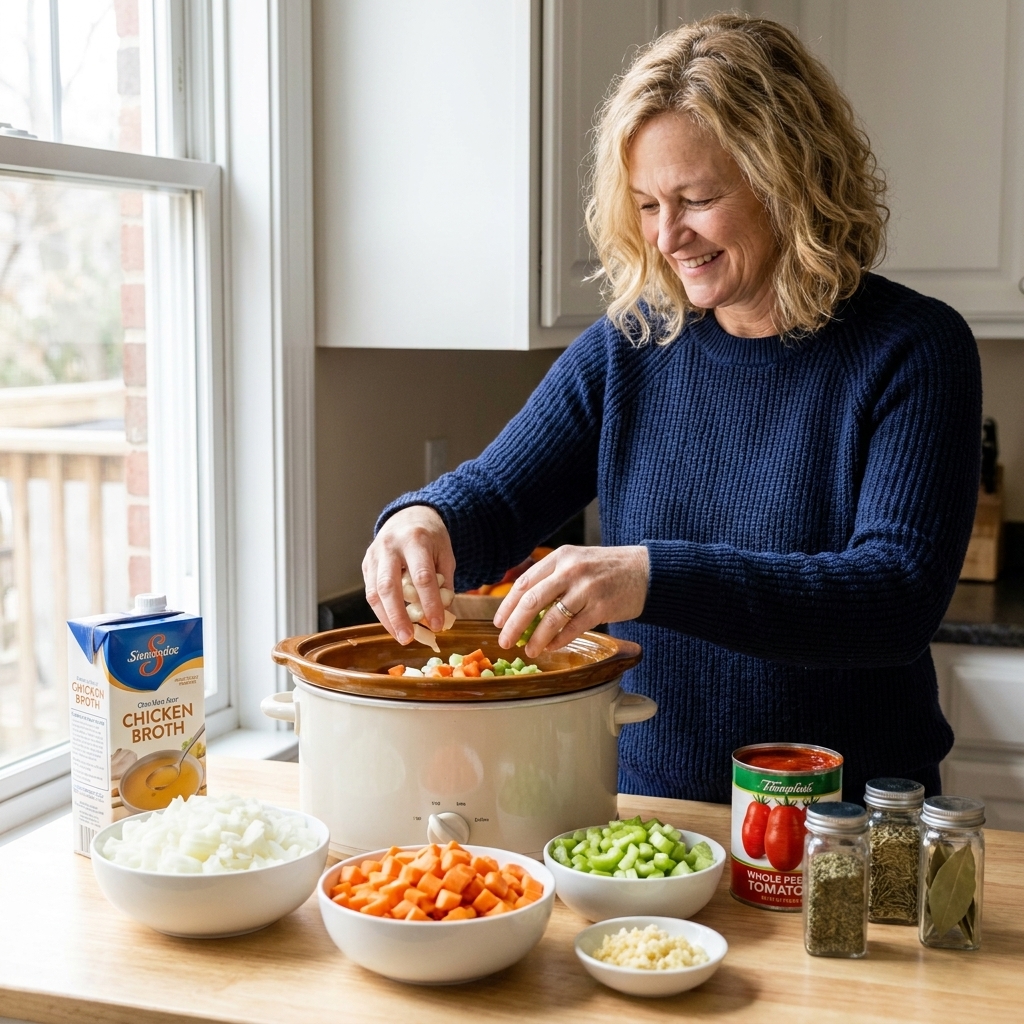
The big idea: slow cooker soup is gentler and less evaporative
If you have a beloved stovetop soup recipe and you want that same cozy flavor without standing at the stove at 5 PM, you can absolutely convert it. You just need to account for three things the slow cooker does differently:
- It traps moisture. Less evaporation means soups can end up thinner if you use the same liquid as the stovetop version.
- It heats gradually. Ingredients soften more slowly at first, then simmer for a long time once hot.
- It hates last-minute rescues. You cannot crank the heat and boil off extra liquid fast at the end like you can on the stove.
Once you know a few rules, you can adapt almost any soup in minutes. I do it constantly with my mom’s old recipes and my own “whatever’s-in-the-fridge” soups.
Quick conversion checklist (my weeknight shortcut)
Before we get into the details, here’s the shortcut I use when I’m scribbling a recipe into my slow cooker notebook.
- Reduce liquid by 10% to 25%. Start with less broth than the stovetop recipe calls for. You can always add more at the end.
- Do any key browning first. If the stovetop recipe starts with browning meat or sautéing onions, do it on the stove or in a skillet first for the best flavor.
- Cook low and slow for structure. Most soups do well on LOW 6 to 8 hours or HIGH 3 to 4 hours, but tender veggies and seafood need less time.
- Hold back dairy and delicate add-ins. Add milk, cream, sour cream, cheese, pasta, rice, seafood, and fresh herbs near the end.
- Thicken at the end. Use a slurry, mashed beans, potato, or a roux made separately if needed.
- Undersalt early, finish at the end. Slow-cooked flavors get cozy and concentrated, and you can always add salt. Taking it out is harder.
Step-by-step: convert any stovetop soup
Step 1: Identify the soup type
This changes the timing and add-ins more than anything else.
- Brothy soups: chicken noodle, vegetable, minestrone, taco soup.
- Starchy soups: potato soup, chowders, soups with rice or pasta.
- Bean and lentil soups: split pea, lentil, ham and bean.
- Meaty soups: beef and barley, chili-like soups, sausage and kale.
- Seafood soups: clam chowder, fish stew.
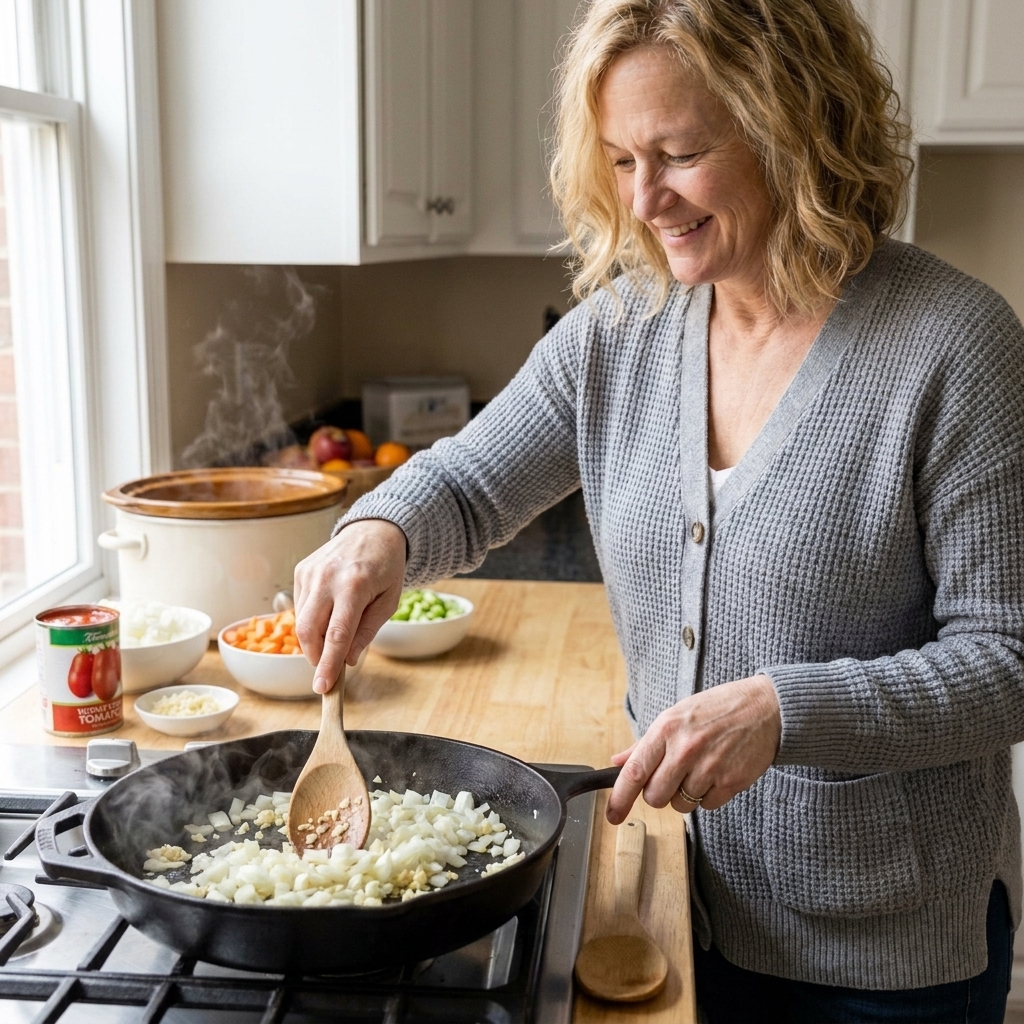
Step 2: Decide what must be sautéed (and what can be dumped in)
I love a true dump-and-go, but some soups rely on stovetop steps for flavor.
- Always worth sautéing first: onions, garlic, tomato paste (1 to 2 minutes), spices that bloom in oil (curry powder, chili powder), and any meat you want browned.
- Usually fine to add raw: carrots, celery, potatoes, canned tomatoes, beans (canned), broth, dried herbs.
- Exception: if your recipe uses a roux (butter + flour cooked together) for thickening, do that on the stove and add it later, or use a different thickener (more on that below).
Step 3: Adjust the liquid ratio
This is where most conversions go off the rails. Because a slow cooker lid keeps evaporation low, a stovetop soup’s liquid amount often makes a slow cooker soup too thin.
My rule: start by reducing total added liquid (broth, water, tomato juice, wine, etc.) by about 1/2 to 1 cup per 6 to 8 cups of liquid in the original recipe (roughly 10% to 25%).
Quick reality check: slow cookers have personalities. Wide inserts, newer “runs hot” models, or lids that vent a bit can change how much liquid you need. Start conservative the first time you convert a recipe, then adjust next batch.
How to choose the right reduction
- Reduce closer to 10%: bean soups, lentil soups, soups with lots of starch (potatoes, rice). These naturally thicken.
- Reduce closer to 25%: very brothy vegetable soups, tomato-based soups, soups with lots of watery vegetables (zucchini, mushrooms).
- If your stovetop recipe says “simmer uncovered”: that’s your biggest clue it relies on evaporation. Reduce liquid more aggressively for the slow cooker.
A note on canned tomatoes
Keep canned tomatoes as-is. Do not drain unless the original recipe specifically drained them. Just count their liquid as part of your “total liquid” when deciding whether to reduce broth.
Step 4: Convert the cook time
Stovetop soups often simmer 15 to 45 minutes. In a slow cooker, you are trading speed for hands-off time.
- Most soups: LOW 6 to 8 hours or HIGH 3 to 4 hours
- Chicken pieces (thighs, breasts): LOW 3 to 5 hours, HIGH 2 to 3 hours, then shred if you want. Start checking early if you are using small boneless chicken breasts.
- My doneness rule: chicken is done when it hits 165°F / 74°C in the thickest part and shreds easily. If it is done, pull it. Do not let it “hang out” for hours just because the timer has time left.
- Ground meat: brown first, then LOW 4 to 6 hours or HIGH 2 to 3 hours
- Soft vegetables (zucchini, spinach, peas): add in the last 30 to 60 minutes
- Seafood: add near the end once the soup is hot. Shrimp and scallops usually need 5 to 10 minutes, flaky fish 10 to 15 minutes, firmer fish 15 to 25 minutes. Mussels and clams cook until they open, often 5 to 15 minutes depending on size.
My mom tip: If your day is long, it’s safer to choose a soup that is forgiving on LOW (beans, lentils, beef). Delicate veggies and dairy-based soups need a little more babysitting at the end.
Step 5: Mind the fill line
For safe, even heating, keep the insert about 1/2 to 2/3 full. Too full can heat slowly and cook unevenly. Too empty can cook fast and reduce more than you expect.
Dairy in slow cooker soups (how to avoid curdling)
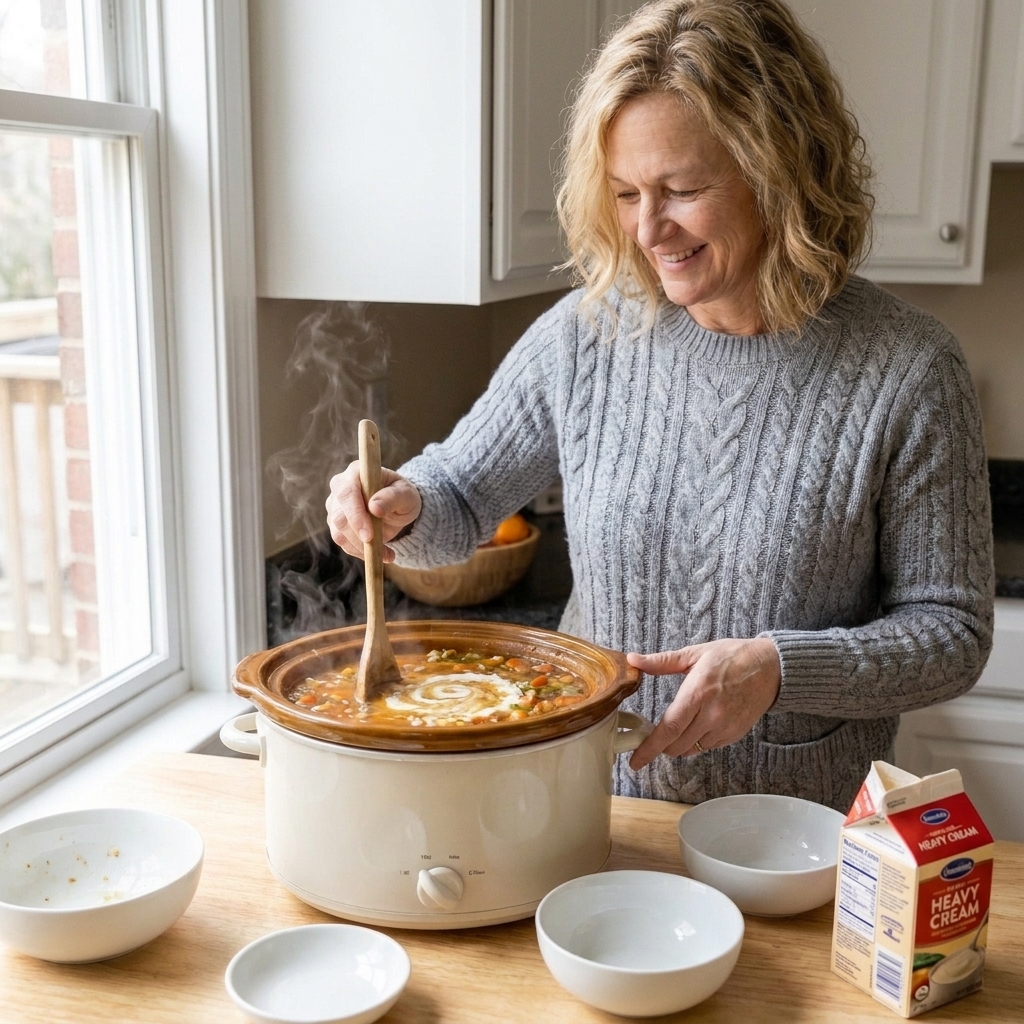
Dairy is the number one “why did this happen to me” moment in slow cooker soup conversions. The fix is simple: add dairy late and keep the heat gentle.
When to add dairy
- Milk and half-and-half: stir in during the last 20 to 40 minutes, ideally on LOW.
- Heavy cream: last 15 to 30 minutes (it’s more stable, but I still add it late).
- Sour cream, cream cheese: last 15 to 30 minutes, whisked smooth first with a little hot broth in a bowl, then stirred in.
- Shredded cheese: last 10 to 20 minutes, off HIGH heat if you can. Add gradually and stir until melted.
Temperature tips that actually help
- Avoid boiling. Many slow cookers on HIGH can bubble hard around the edges. If you’re adding dairy, switch to LOW first.
- Temper thicker dairy. Mix it with a ladle of hot broth before adding so it warms up gradually.
- Watch acidic soups. Tomato-heavy or lemony soups are more likely to curdle dairy. In those, I stick to heavy cream, or I swirl in dairy right before serving.
Can you use evaporated milk?
Yes. It holds up better than regular milk. Add it near the end just like milk, but it is a great option if your slow cooker tends to run hot.
Pasta, rice, potatoes, and grains: avoid mush
On the stove, pasta and rice cook fast and you can stop them right on time. In the slow cooker, they can overcook quickly once they pass “tender.” Here’s how I handle the usual suspects.
Pasta
- Best option: cook pasta separately and add to bowls when serving.
- If you want it in the slow cooker: add small shapes only near the end and start checking at 10 to 15 minutes (often on HIGH), stirring once or twice. Depending on the pasta and your cooker, it may take 10 to 30 minutes. Stop when it is just tender.
Rice
- Best option: cook separately and stir in at the end.
- If adding to the slow cooker: use long-grain white rice and add during the last 45 to 90 minutes (timing varies a lot by cooker). Brown rice needs longer and can drink up broth, so plan extra liquid.
Potatoes
- Chunked potatoes: add at the beginning, they do great.
- For creamy potato soup: cook potatoes until very tender, then mash or blend part of the soup to thicken before adding dairy.
Barley, farro, and tougher grains
These are slow-cooker friendly, but they absorb liquid. Either add extra broth up front or plan to loosen with more broth near the end.
Thickening slow cooker soup (without losing your mind)
If the stovetop version reduces uncovered, you’ll often need a slow-cooker thickening plan. Here are options I actually use on weeknights.
Option 1: Cornstarch slurry (fastest)
Mix 1 tablespoon cornstarch + 1 tablespoon cold water (double it for big batches). Stir into hot soup, cover, and cook on HIGH for 10 to 20 minutes until slightly thickened.
Option 2: Flour slurry (a little softer)
Whisk 2 tablespoons flour + 2 tablespoons cold water until smooth, then stir in and cook 20 to 30 minutes. Flour needs a bit more time to lose that raw taste.
Option 3: Blend part of the soup (best flavor)
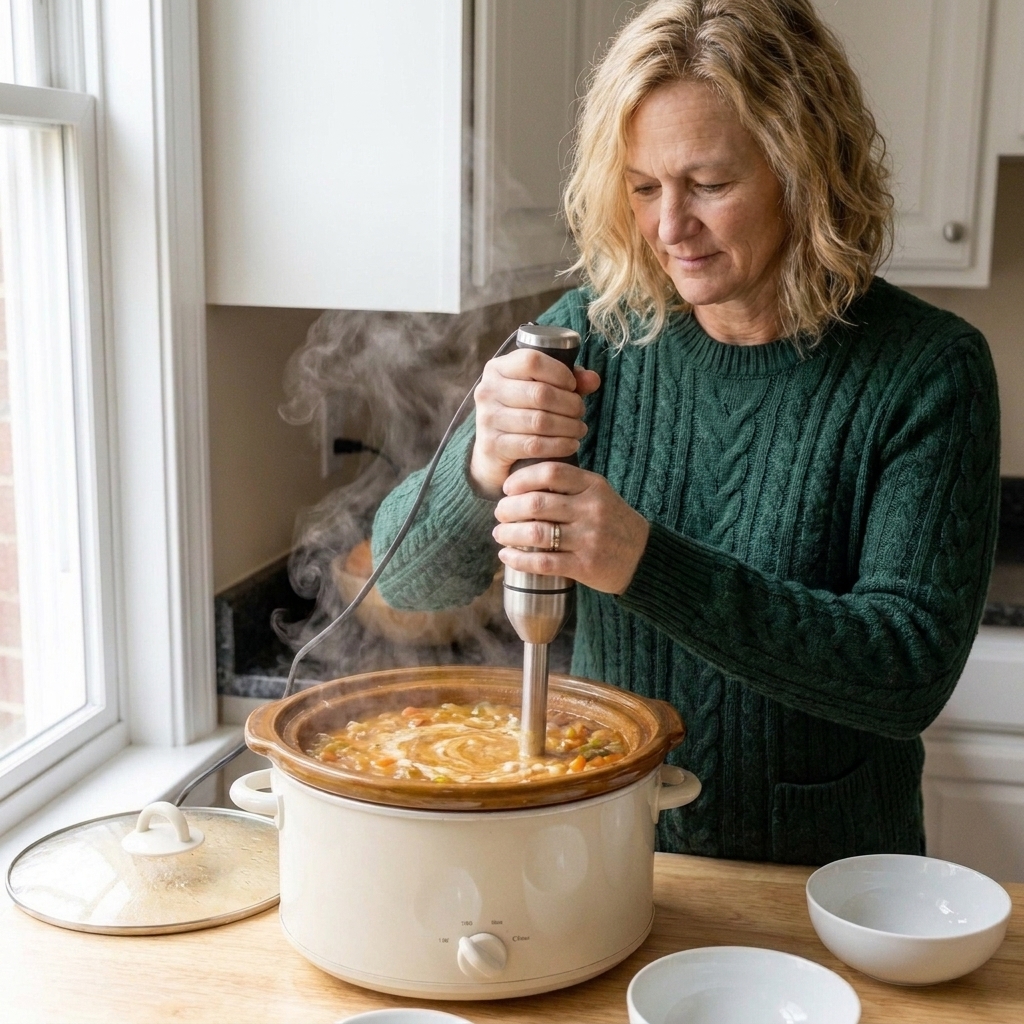
Scoop out 2 to 3 cups of soup (more if you want it thicker), blend until smooth, then stir back in. This works beautifully for vegetable soups, bean soups, and chowders.
Option 4: Mash beans or potatoes
Use a potato masher right in the crock. It’s low effort and gives you a hearty, rustic texture.
Option 5: Roux, made separately (classic chowder move)
If your stovetop soup starts with a roux, make it in a small saucepan near the end: melt butter, whisk in flour, cook 1 to 2 minutes, then whisk in a cup of hot broth from the slow cooker to smooth it out. Stir back into the crock and cook on HIGH 15 to 20 minutes before adding dairy.
Ingredient rules (the ones that save batches)
Meat
- Beef stew meat: loves LOW 7 to 9 hours. Brown first if you want deeper flavor.
- Chicken breast: can dry out if it cooks too long. I prefer thighs for all-day soups, or I check breasts early and pull them as soon as they hit 165°F / 74°C.
- Sausage: brown first to render fat, unless you are using fully cooked sausage (then slice and add later).
Beans (canned vs dry)
- Canned beans: rinse and add at the beginning or mid-cook.
- Dry beans: use caution. Slow cookers may not reliably reach a sustained boil, which matters for kidney beans (they contain a natural toxin that is neutralized by boiling). For safety, boil kidney beans hard for at least 10 minutes (after soaking, if you soak) before adding them to the slow cooker, or use canned kidney beans, or use a recipe specifically tested for dry beans.
Leafy greens
- Kale: can go in for the last 30 to 60 minutes and hold up well.
- Spinach: stir in at the very end, 5 to 10 minutes before serving.
Fresh herbs and citrus
Fresh basil, dill, parsley, and a squeeze of lemon wake up slow cooker soups beautifully, but add them at the end. Long cooking dulls their flavor.
Common stovetop lines, slow cooker meaning
- “Simmer uncovered 20 minutes”: reduce broth by 15% to 25%, then thicken at the end if needed.
- “Bring to a boil”: in a slow cooker, just cook until hot and bubbling. Do not chase a rolling boil.
- “Cook until reduced by half”: you likely need a thickener or you need to start with substantially less liquid.
- “Add cream and heat through”: add cream in the last 15 to 30 minutes, ideally on LOW.
- “Cook pasta in the soup”: cook separately or add near the end only.
Two real-life conversions (copy the pattern)
Example 1: Stovetop chicken noodle soup
Stovetop version: sauté onion, add broth, simmer chicken, add noodles.
Slow cooker conversion:
- Sauté onion, celery, carrot in a skillet (optional but delicious).
- Add to slow cooker with chicken thighs or breasts, broth (start with about 3/4 of what the stovetop recipe uses), dried herbs, salt (go light at first).
- Cook LOW 4 to 6 hours, but start checking chicken earlier if pieces are small. Pull it at 165°F / 74°C, then shred.
- Add noodles during the last 10 to 25 minutes on HIGH, stirring once or twice, or cook noodles separately and add to bowls.
- Finish with parsley and lemon.
Example 2: Creamy potato soup
Stovetop version: cook potatoes, make roux, add milk, simmer until thick.
Slow cooker conversion:
- Add potatoes, onion, garlic, broth (reduced by about 10% to 15%), salt, pepper to slow cooker.
- Cook LOW 7 to 8 hours, until potatoes are very tender.
- Mash or blend part of the soup to thicken.
- Stir in warmed milk or half-and-half in the last 30 minutes on LOW.
- Add cheese at the end if you like, then serve.
Troubleshooting (because soup happens)
My soup is too thin
- Remove the lid and cook on HIGH for 20 to 40 minutes (this helps a little, but slow cookers still do not evaporate like a pot).
- Use a cornstarch slurry.
- Blend or mash part of the soup.
My soup is too salty
- Add more unsalted broth or water.
- Add more no-salt “stuff” (extra cooked rice, beans, potatoes, or veggies) to stretch the batch.
- If you want to try it, a peeled potato chunk can round out the flavor a little, but it does not reliably remove salt. Dilution and stretching are the real fixes.
My dairy curdled
- Next time, add dairy later and avoid HIGH.
- For this batch, blending can improve texture, or strain out bits and use it as a “rustic” base. It will still taste good even if it looks imperfect.
My vegetables are mushy
- Add tender vegetables later.
- Cut veggies larger.
- If your slow cooker runs hot, shorten the cook time or use LOW only.
FAQ
Can I convert any soup to the slow cooker?
Most of them, yes. The trickiest are soups that depend on fast cooking (seafood-heavy) or careful thickening (roux-based chowders). Those still work, you just shift seafood and dairy to the very end and choose a thickening method that fits the slow cooker.
Do I need to stir slow cooker soup?
Not usually. Stirring once halfway through is nice if you are home, but most soups do fine untouched. The only time I recommend stirring is after adding thickeners, dairy, pasta, rice, or seafood near the end.
Is LOW always better than HIGH?
LOW is more forgiving and gives you better texture for chicken breast and dairy-based soups. HIGH is helpful for a shorter day or when you add pasta near the end and want it cooked quickly.
Can I lift the lid to check it?
You can, but every peek lets heat escape. Try to check quickly and avoid repeated lid lifting early in the cook time.
Any food safety tips?
Use a thermometer for poultry (165°F / 74°C). For leftovers, cool soup quickly and refrigerate promptly, then reheat until steaming hot.
My simplest rule to remember
If you only remember one thing, make it this: use a little less liquid than the stovetop recipe, and add dairy and starches at the end. That one shift will save you from watery soup, curdled cream, and noodles that disappear into the broth.
And if your first conversion is not perfect, that is normal. Slow cookers have personalities. Mine definitely does. The good news is soup is forgiving, and you will get better with every batch.